Tell Test result
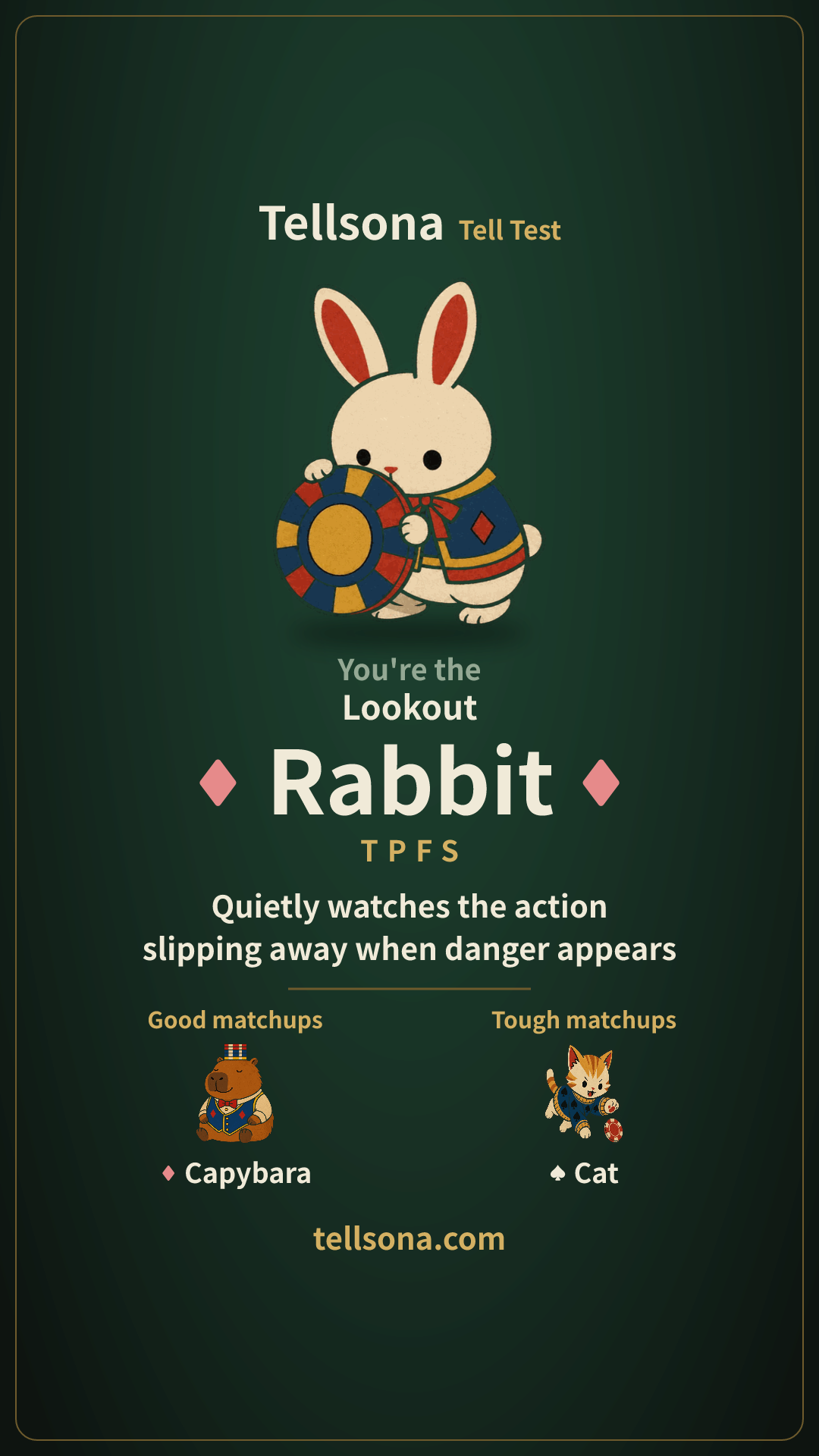
LookoutRabbit
Tellsona No.14
The Observer
TPFS
Quietly watches the action
slipping away when danger appears
What kind of player you are
You play few hands, and once you're in, you quietly watch. You rarely bet first, and when you do, it's small. When an opponent bets into you, you often fold. Your losses are very small, and you don't force risky fights. On the other hand, what you collect is small too. If you don't bet first even with a strong hand and fold when bet into, opponents can see cards cheaply, and you can't grow the pot.
For example, you open Broadway hands and pairs from the CO or the BTN, and in the BB you fold fairly often even to the SB's open. On the flop you check, and when your opponent bets, you fold unless you have top pair or better. When you bet yourself it's 1/3 pot, and even with a set or better you don't bet big. When someone bets big on the turn, you sometimes fold even top pair.
Your tendencies
- Hands playedFewerYou tend to narrow your hands too much. You enter fewer pots than GTO and tend to drop hands worth defending from the blinds or playing in position. What slips away is the value of hands you could have entered cheaply.
- BettingLessYou tend not to bet first. You often check or call to see what happens and tend to hand the initiative to your opponent. The typical cost is not getting full value from strong hands.
- FoldingFolds easilyYou tend to let go when bet into. Facing a big bet with a medium-strength hand, you often fold. It avoids big losses, but you tend to get bluffed off your hand.
- SizingSmallerYou tend to bet too small. Your bets are cheap and your losses small, but you collect less with strong hands. To opponents, your bets tend to become a cheap look at the next card.
Your prescription
Widen what you enter with.
Read why
From the BTN and CO, also open 65s, J9s, and K9o. In the hands you do play, when you have top pair, bet 2/3 pot yourself. Betting small, then folding when raised, is the combination opponents can exploit most cheaply. Even when you're raised, keep top pair top kicker and overpairs until the turn.
Strengths & weak spots
Your strengths: You rarely lose much at once, so your bankroll lasts
Your strengths: You watch opponents closely, so you notice their habits
Your strengths: Small sizes let you keep the pot in check
Your weak spot: It hurts when opponents fire cheap bluffs again and again.
Your weak spot: You fold easily, so opponents' bluffs chase you off
Your weak spot: You enter and attack rarely, and you collect only a little even with strong hands
Same choice as GTO
– / –
This is how many of the 32 questions you answered the same way as GTO. It is not a judgment of skill or results. Record your hands at the table to see the same measure in real play.
We sent you a confirmation email
Install the app


Tap “Open and save my result” in the email → the GTO for all 32 hands appears in the app
We sent you a confirmation email. Tap “Open and save my result” in it to see the GTO for all 32 hands in your browser. You can also open it in the phone app with the same email address.
Didn’t get it? Send againHow it differs from GTO
Two areas show the biggest gap from GTO. The first is facing a bet on the flop. GTO defends medium-strength hands with a call. The second is holding a strong hand. GTO bets itself and also plays a little wider.
Matchups at the table
Matchups as seen from the Lookout Rabbit. Tap a type to see the details of how the two match up.
Good matchups
Tough matchups
Every type
 No.01Ironhorn RhinoEven
 No.02Constricting SnakeEven
 No.03Rampaging BearEven
 No.04Snapping WolfTough
 No.05One-Kick KangarooEven
 No.06Gap-Striking FoxTough
 No.07Dashing CheetahEven
 No.08Mischief CatTough
 No.09Unbothered CapybaraEdge
 No.10Shell-Keeper SnailEven
 No.11See-It-Through GiraffeEdge
 No.12Hugging KoalaEven
 No.13Cautious ElephantEdge
 No.14Lookout RabbitSame type
 No.15Whimsical AlpacaEven
 No.16Pecking SparrowEven
More details
Where it sits among the 16 types
How common this type is
Share your result
Your tell updates with the hands you actually play
 Tell Test form?Form with real play
Your 32 answers become your first 32 hands in  log(GTO), the live poker hand-history, GTO grading and play-style analysis app.
Your 32 answers become your first 32 hands in log(GTO).
When you open the app, your result is updated using these 32 answers as the base, combined with your real-play records.
Once the app is installed, come back to this page and tap “Open in the app”.
▶ Open in the appScan with your phone to open in the app
No hands to record right now?
Without an account, your Tell Test result may disappear from this device.
Create an account firstWe emailed you a link to save your result
Open it to save your result. You can also open this result in the app by entering this email address.
Didn’t get it? Send again